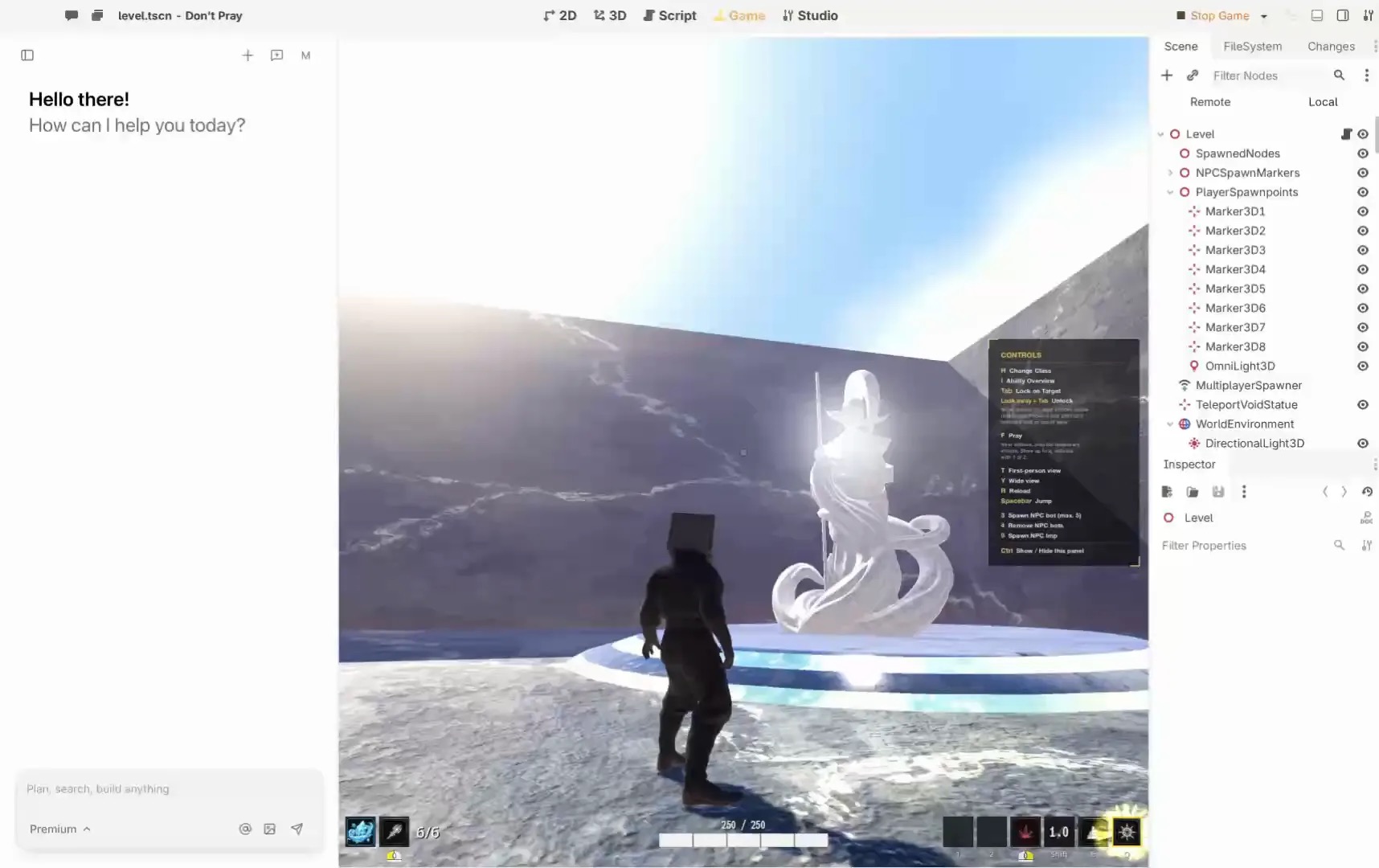
For a studio, the cheapest first prototype can be the expensive choice if the team cannot maintain or distribute it. Evaluate Summer Engine if an agent working with an editable engine fits your production process. Compare it with a browser-first tool such as Rosebud and an open engine such as Godot against the same release requirements.
Compare the obligations
| Decision | Evidence to obtain |
|---|---|
| Cost | Seat, agent, generation and hosting charges at expected usage |
| Ownership | Terms for project files, generated assets and commercial use |
| Portability | Editable files, dependencies, export format and recovery process |
| Delivery | Target platform prerequisites, platform fees and actual artifact test |
Request current terms for the plan and region you will actually buy. Public pricing is not a completed checkout or legal advice.
Model the total cost
Estimate monthly cost as editor seats plus agent subscriptions or usage plus generation, hosting and distribution. Build a low and high usage scenario: include repeated revisions, failed generations and all contributors. Summer’s pricing describes its plans; using a separate agent may add charges. Rosebud’s plan page describes its credit and feature boundaries. Check whether the team needs paid access for code downloads, privacy or commercial use.
Separate ownership from portability
Ask who may commercially exploit the game, who owns or licenses generated assets, and whether the vendor’s terms permit your intended distribution. Then ask a different question: can the studio retrieve and edit the files needed to continue the project? A license to use output does not by itself guarantee a portable editor project, working dependencies or future access to a service.
Godot’s license page describes the engine’s MIT license and distribution notice. It does not grant rights to third-party assets. For every tool, retain the applicable terms and asset licenses with your project records.
Make export a release gate
List your target OS, device and store. Build a small representative scene with input, audio and saved state, then export and open the artifact on each target. Record SDK, signing, account and review requirements. Godot’s export documentation explains export templates; Summer’s export guide distinguishes its publication paths. Support for a platform family does not guarantee acceptance of a particular game.
Run a short procurement exercise
- Give each candidate the same small brief and time budget.
- Have two team members change a gameplay rule and recover an earlier version.
- Inventory all dependencies, rights and projected charges.
- Produce an artifact for the actual target and test it on a clean device.
- Record blockers, terms and the date checked; revisit them before purchase.
This is a proposed evaluation protocol. No performance scores or completed tests are claimed here.
Worked example: two-person puzzle studio
Suppose two developers intend to sell a desktop puzzle game after six months. They need private work, a repeatable build, the ability to change a rule without the original author, and a way to recover project files if a hosted service is unavailable. They expect frequent agent revisions and commission music separately. The team should cost two seats and the expected AI usage, not just a single free trial.
First obtain the current plan terms for each candidate. On its pricing page, Summer lists free manual editor and export use, a limited hosted AI allowance, and paid plans with private projects. Rosebud’s pricing page distinguishes credits, private projects, commercial rights and code export by plan. The studio should verify the exact applicable tier and billing terms, including whether a separate coding agent adds its own charge.
Then give each tool the same small level. One developer builds it; the other changes a win condition and makes a release candidate from documented instructions. Export an actual artifact and open it on a clean target machine. Finally, restore the project from the team’s backup and repeat the change. Record which inputs, services and credentials were necessary. This proposed exercise provides evidence for the studio’s own decision; this guide does not report its results.
Questions to put to each vendor
- Which plan covers every contributor, private collaboration and commercial distribution?
- What is metered: requests, compute, generations, storage or exports? What happens when an allowance is exhausted?
- Can we retrieve source, scenes, assets and dependencies, and in which formats?
- Which rights apply to our inputs, generated outputs and third-party assets? Can terms change during the project?
- What happens to private projects and downloads if a subscription ends?
- What support and platform-specific prerequisites apply to our intended release?
Save the answers and applicable terms with a date. A vendor’s feature page is a useful starting point, but it may not answer the contractual question for your plan and jurisdiction.
Three separate exit questions
Access: can the team obtain a copy of its project and assets? Editability: can another developer open and change the important rules in a supported tool? Distribution: can the team produce and ship an artifact for the actual destination? A “download” may answer only the first question. Keep a dependency inventory with versions, licenses, build tools and any account-bound services so that a future rebuild is not dependent on one person’s memory.
Godot’s MIT license permits studying and modifying the engine subject to its terms, including the required notice. That is useful evidence for engine-source access; it does not establish that every third-party plugin or generated asset is similarly licensed. Rosebud’s published code-export feature should likewise be evaluated against the actual files and dependencies the team receives, rather than assumed to be a complete migration path.
Make a cost worksheet
For each month, enter the number of seats, subscription price, expected agent turns and asset-generation budget. Add a higher-usage scenario for a difficult iteration month. Include store accounts, hardware for target testing, cloud services, commissioned assets and taxes where applicable. Do not treat a vendor’s rough credit estimates as a guaranteed project price: Rosebud states that credit use depends on the model and task size.
At the end of the trial, compare the estimated cost with the time spent on manual corrections and team handoffs. A less expensive subscription may still be unsuitable if the studio cannot inspect the behavior it must maintain. Conversely, an open engine can reduce license cost while requiring separate integration and support work.
Frequently asked questions
Does commercial use mean full ownership?
No single label answers all rights questions. Read the relevant terms for the project, outputs and inputs, and check third-party licenses separately. Obtain professional advice for a material contract decision.
Is export the same as store approval?
No. Export creates an artifact; the destination can have signing, account, technical and content requirements. Test the artifact on the target and follow the store’s current submission process.
Should we lock a tool before a prototype?
Use a small, time-limited trial to expose constraints first. Record the decision and revisit it when target platforms, team size or commercial terms materially change.
Want to play instead? Discover games on Summer Games.
About this guide
By Summer. Disclosure: Summer owns this publication and it promotes Summer products. Recommendations reflect the stated use case; product information comes from the official sources linked above, checked November 8, 2026. We have not claimed comparative hands-on tests.